Today's consensus protocols can't provide high transactions throughput needed to address real use cases:
Highly scalable protocols but highly limited by fees (i.e., Ethereum).
High transactions throughput but lack scalability.
One of the alternatives to achieve higher transactions throughput on blockchain is through sharding (more on this later).
These shards can operate as independent blockchains.
Despite this, a sharded chain isn't the only answer to blockchain scalability issues...
They are sharded, but:
Can't process transactions across shards---> Atomic composability is broken.
💔 Bridging, wrong
On single blockchains composability is easy, because transactions can be processed by the same chain.
Across shards or different blockchains, composability is hard because not all blockchains are compatible between each other.
This has made DeFi slow and hard to use:
DeFi without Atomic composability--->Hard to use.
DeFi with Atomic composability--->Even your grandmother can use it.
Let's dig in.
Atomic composability
Atomic composability is a major issue on DeFi.
Unfortunately scaling solutions like Ethereum 2.0, Polygon, Optimism, Avalanche, Near and Polkadot, all massively compromise or eliminate this very important feature for DeFi. claimed CoinTelegraph on a recent report (see Does the future of DeFi still belong to Ethereum?)
Lets break it down:
Atomicity--->single transactions executed only as one.
For example: You want to swap $ETH for $LUNA. Currently, this is solved through bridges (it's too complex to explain how bridges works, see Blockchain bridges if you want to dig in).
With atomicity, you don't need to rely on a "third party" (in this case, a bridge) for swapping your tokens: the swap is made once without delay.
Composability--->interoperability between applications.
For example: So you need to swap $ETH for $LUNA. If $ETH and $LUNA were "composable" there is no need in using a bridge. You just swap your tokens all at once.
Atomic Composability is the ability to compose multiple applications at once combined with atomicity as a one-time transaction.
For example: If $ETH and $LUNA were "Atomically composable", you just swap them. No bridge and no complex tokens involved.
So with Atomic Composability: ✅ wLUNA or wrapped tokens, gone. ✅ complexity, gone. ✅ bridging risks, gone. ✅ even your grandmother could use it, yes.
We even aren't talking about the wide range of bridging's risk involved:
"Bridges are in early stages of development claimed by Ethereum (see Blockchain bridges).
💔 Layer 2, wrong
How rollups broke DeFi
Ethereum scaling solutions involve layer 2.
These layer 2 solutions are known as rollups or sidechains.
With rollups, transactions are taken out of the mainnet.
They solve scaling but break atomic composability:
Rollups and Ethereum mainnet have different protocols.
Atomic composability is broken.
Transactions have to first be processed by layer 2 and only then submitted to Ethereum mainnet.
Centralization > Decentralization
Vitalik Buterin wrote that as we move into The Merge, there is the possibility of only one particular rollup committing transactions:
“We get a world where, block production is centralized, block validation is trustless and highly decentralized, and censorship is still prevented” claimed Vitalik Buterin on Engame.
Still, there isn't one single rollup that can take "the majority" of Ethereum transactions.
This would lead us to a multi-rollup future for Ethereum.
The issue here is that a multi-rollup future may create more MEV opportunities for validators on Ethereum 2.0 and thus, centralization of block production.
But how a multi-rollup future could improve centralization?
From here, things start to go off rails, so take a deep breath.........now let's move on.
What is Miners Extractable Value a.k.a. MEV and what does it have to do with centralization?
Miners on Proof-of-Works (PoW) systems like Ethereum and Bitcoin have a mempool.
A mempool is a list of all pending transactions to be mined.
MEV---> A miner putting their own transactions before everyone else's transactions on the mempool.
This is known as front-running.
Why would they do that? Because they can profit from. 🤑
On PoW this could even be healthy for the network since i.e. liquidations don't rely on a single party, and it's almost impossible to know who is going to validate which block next.
On Proof-of-Stake (PoS) things change...
They incentivize centralization:
Since Proof-of-Stake reward validators according to the amount of staked assets, it's more predictable to know who is going to validate the next block of transactions.
The more assets you have staked the more you are able to mine blocks.
This is where centralization comes in, as a single validator (the one with the more assets staked on) can take advantage of almost all MEV opportunities on a network.
To worsen things even more, this also incentivizes validators to group up and discover MEV opportunities faster.
And, remember...is a matter of time till Ethereum goes from PoW to PoS...
It can process a fixed number of parallel shards: specifically 2^256 shards which are practically, unlimited.
🧠 For the giga-brains: 2^256 shards is enough to fit all possible combinations of Bitcoin addresses in Cerberus' shards 79 billion billion billion times.
But, what is a shard?
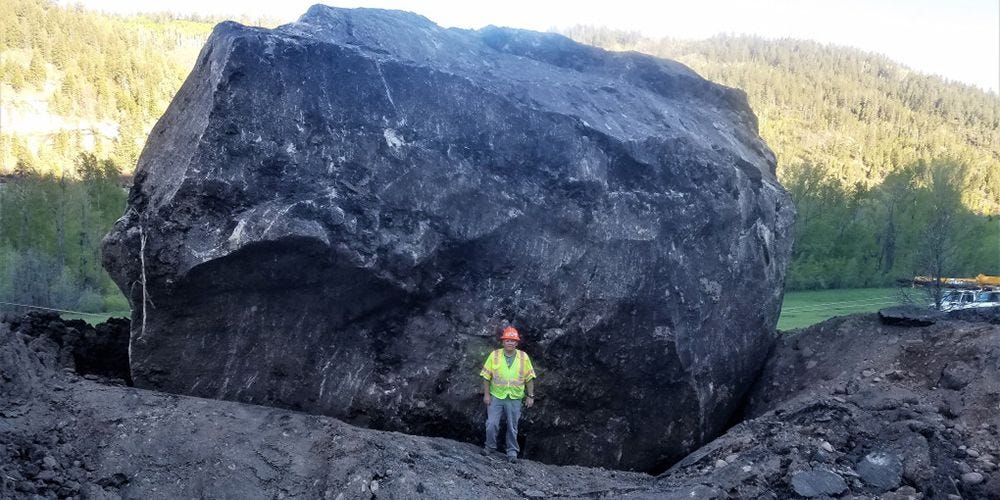
Imagine you are this little dude right here. Bae asked you if you could bring the giant rock to the trash can.
Because you are sooo smart, you cut that rock into small little rocks.
Small little rocks are lighter--->Less effort to move them.
Now, imagine cutting that rock into 2^256 little rocks. Now it's easier for you to do bae's task right?
That's a sharded chain. A chain cut in little chains.
And as we say earlier, this is one of the solutions to scalability issues.
Every time a set of nodes, verifies a transaction, a kind of on/off switch in a shard goes:
A transaction is made---> substate---> On---> "bring up"---> Record the transaction to the ledger.
A transaction was made---> substate---> Off---> "shut down"---> The transaction can't be committed again.
This is made across all 2^256 Cerberus' shards.
And as transactions are made they get a unique ID.
Something like a unique and long sequence of numbers.
For example: 0983e8ca19a61b086bcb975a3b1df332cb58e2a43da0b0e5a7dcd64e86237efb
This ID is used by Cerberus to map the transaction to a specific shard space (shards).
Do you get where all of this's going?
Since transactions can have a unique shard space and every shard space across the chain is independent of each other: you now have 2^256 possible spaces to fill with transactions.
But, how to reach consensus in a sharded chain?
⛓ The Cerberus way
Cerberus was two ways of reaching consensus:
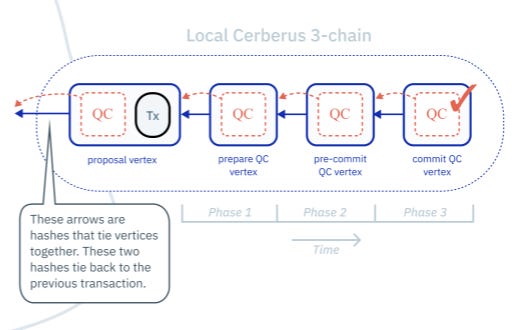
Local Cerberus--->consensus on a single shard--->3-chain
A 3-chain is the proof that nodes from a single shard approved a transaction.
🧠 For the giga-brains:
Every node generates a proof---> A "QC"
After the proof is generated is organized---> A "vertex".
All this forms the 3-chain since every proof is chained backwards to the previous "vertex".
And...
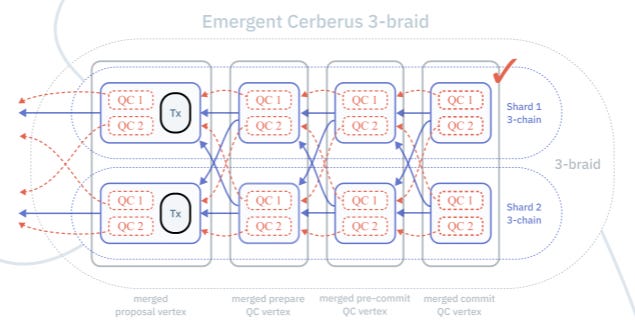
Emergent Cerberus--->consensus across shards.
Emergent Cerberus is more complex.
It uses a "braided consensus" across shards---> More than one 3-chain--->"3-braid"
Here, every "QC" proof is shared across nodes from each shard.
This lets every set of nodes know the voting outcome of every other shard.
🧠 For the giga-brains:
All of this, to finally get "cross-shard atomic composability":
The ability to communicate between independent shards.
So, how Cerberus get the most out of his cross-shard atomic composability?
With Partial Ordering.
Partial ordering
Is the ability to conduct transactions in parallel, instead of having to create a "waiting list" of transactions (like in 99,9% of blockchains).
In Ethereum, transactions are privileged by how much the user is willing to pay in gas fees.
Cerberus had already achieved to demonstrate at small scale cross-shard transactions and atomic composability.
Atomic composability
Cerberus achieved to stream a website and game with images, sound, and text.
In this case, atomic composability is the ability of streaming image, text, and sound at the same time without latency.
This was already demonstrated by Cerberus in Cassandra's tesnet:
A blockchain without atomic composability would have high latency and asynchronized images, text, and sounds.
Cross-shard transactions
Cerberus achieved 20K transactions across two different shards with only 25 validators:
... a network of around 25 validators before the aforementioned pending tasks came to bite us. The resulting issues did allows to see quite a large amount of resilience in the network... with a number of recoveries before finally succumbing. claimed Dan Hughes, founder of Radix DLT.
🏁 The Roadmap
Radix's roadmap has four main stages:
Olympia — Released in July, 2021.
Alexandria — Released in December, 2021.
Babylon — Waiting to be released since Q4, 2022 till Q1, 2023.
Xi'an — Waiting to be released during 2023.
The latest Radix release, Alexandria was a developer-focused release on testnet.
Cerberus still remains un-sharded on mainnet with a set of 100 validators.
The fully sharded Cerberus is expected to be released in Radix mainnet in 2023 with Xi'an release.
Still, Cassandra, the Radix testnet, is currently running Cerberus features such as cross-shard consensus and it's the main focus of the team.
By now, the project preparing the next mainnet upgrade: Babylon.
The report included other protocols like Solana, Polkadot, and Algorand.
Still, the challenge I see with Radix is: when the fully-sharded version of Cerberus is going to be released?
We will not see a fully sharded Cerberus consensus till 2023.
So the issue is: where Ethereum is going to be by that time?
Kiln testnet already passed from PoW to PoS past week.
The team is waiting for an acceptable amount of issues to be corrected till The Merge narrative is ON.
And there is A LOT of hype behind, since not only Ethereum ecosystem is going to be benefited from, but also:
Rollups---> Lower gas fees.
Decentralized storage---> Extra node's storage.
ETH 2.0 staking---> Lower amounts of ETH required to stake.
I think the success of Radix is in how much time can advantage Ethereum.
✅ It has the theory. ✅ It has the technology. ✅ Has already achieved some of the theory. ✅ Has already achieved some of the technology. ✅ The community is strong.
But nothing of this matters if Radix isn't able to deliver the fully sharded Cerberus consensus before Ethereum delivers its own sharded chains (2023).
I think till Radix isn't able to demonstrate a fully sharded chain in full effect we can't talk that much about it.
For Radix, it's all a matter of time.
But don't forget: for Ethereum it's also a matter of time.
If Ethereum fails to deliver Ethereum 2.0 at time (again) all these possible Ethereum Killers could be benefited from.
The advantage Radix has is that it has been watching the enemy for eight years: his strengths but also his weak points.
Only if Cerberus can prove on its 2^256 shards, truly atomic composability and infinite linear scalability, the $400T global financial system will belong to Radix.
As Vitalik Buterin wrote:
Ethereum is open to all of the futures, and does not have to commit to an opinion about which one will necessarily win (see Endgame)
If Ethereum 2.0 is delivered at time, does Radix's have plan-b?
Even if eth 2.0 is delivered they are still tight with evm and solidity. Radix asset oriented scrypto language is another component of the great project radix is, so im very confident that radix will be a top 5 project anyway and could flip eth in the long run (3 to 5y after xian).
Fantastic job you did on cerberus consensus breakdown article, best ive seen so far.

Thanks man.
I did my best to try to share an un-biased POV over Cerberus.
It was a hard task try to explain a so complex consensus in an understandable way.
Even if eth 2.0 is delivered they are still tight with evm and solidity. Radix asset oriented scrypto language is another component of the great project radix is, so im very confident that radix will be a top 5 project anyway and could flip eth in the long run (3 to 5y after xian).
Fantastic job you did on cerberus consensus breakdown article, best ive seen so far.